Cohere Developer Experience
A PM analysis for Cohere — where the developer surface undersells Cohere's real enterprise wedge, with public feedback across vendors and themes.
The problem
Cohere has a real wedge in enterprise deployment — data residency, VPC, multi-cloud — but developers discovering Cohere through the playground, SDK quickstart, or model selection flow don't see that wedge. Those surfaces still treat Cohere like a generic LLM vendor. The enterprise buyer converts because of residency; the enterprise user converts because of DX. Both have to work.
My hypothesis
If I analyzed developer feedback across Cohere, OpenAI, and Anthropic — mapped to themes (docs, SDK, playground, error surfacing, model selection) — the DX gap would show itself, and I could recommend where to close it first.
What I built
A dashboard at schlacter.me/cohere-developer-experience with vendor-by-vendor theme breakdowns across Cohere, OpenAI, and Anthropic. A top-level thesis anchors the analysis: close the DX gap between Cohere's enterprise wedge and its developer surfaces. Every theme drills into source posts.
What broke
The vendor comparison is small-N on Cohere (they have a smaller developer community than OpenAI or Anthropic), which means the themes surface but the proportional claims are fragile. I flagged this in the analysis. The real version would pair this with Cohere's internal Discord and support ticket data.
What I learned
The gap between an enterprise buyer's wedge and a developer's first-run experience is a PM problem, not a marketing problem. Enterprise residency is the reason a buyer picks Cohere — but the developer logs in and sees 'another LLM playground.' Nothing communicates the wedge at the moment it matters.
If I kept going
Build a mockup of a Cohere playground that leads with the enterprise wedge — 'pick your deployment region,' 'choose VPC or SaaS,' 'residency on by default.' Test whether enterprise buyers convert to enterprise users faster when the DX reflects the wedge.
Prototype
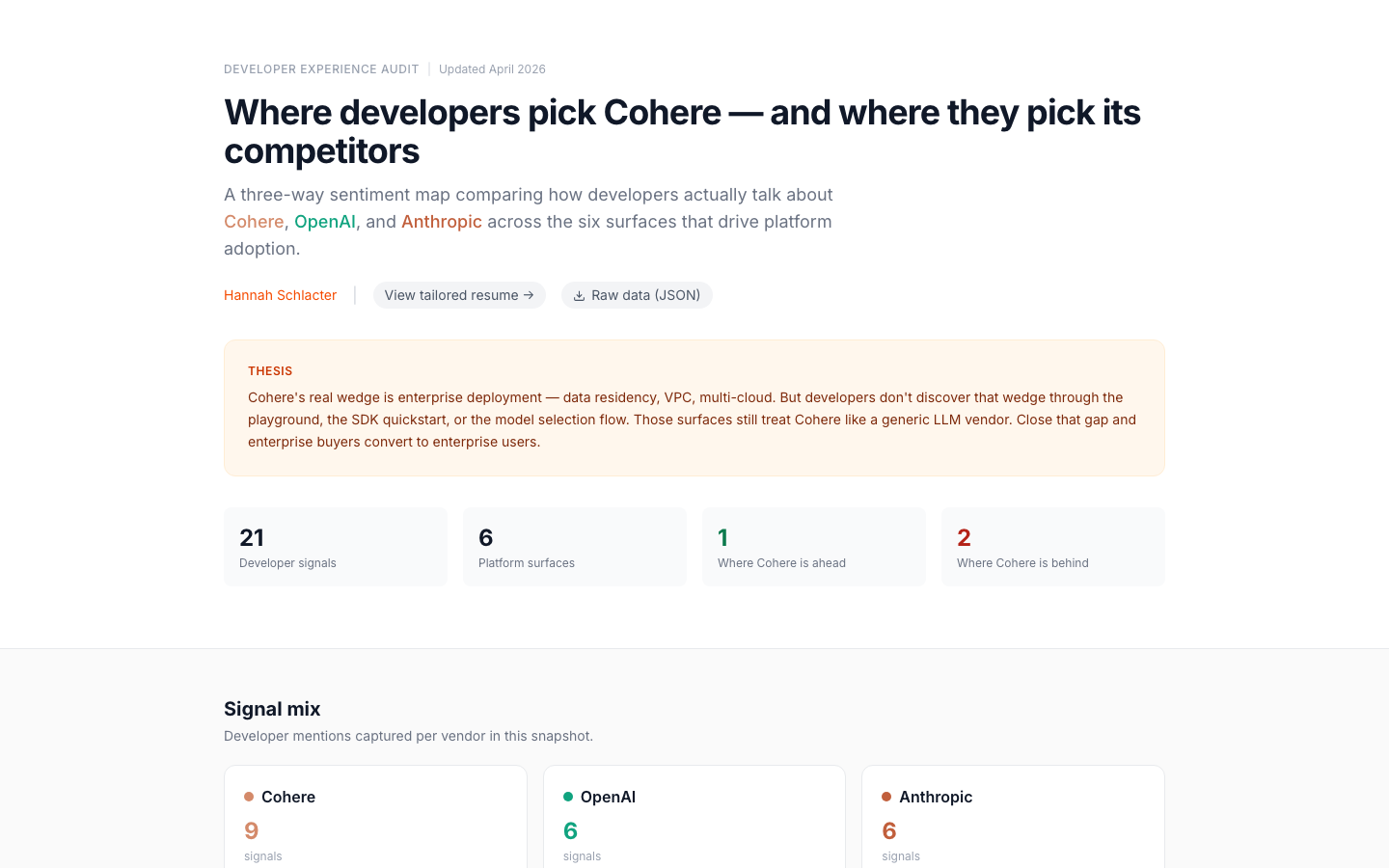
Dashboard hero: Cohere's enterprise wedge vs. its developer surface.
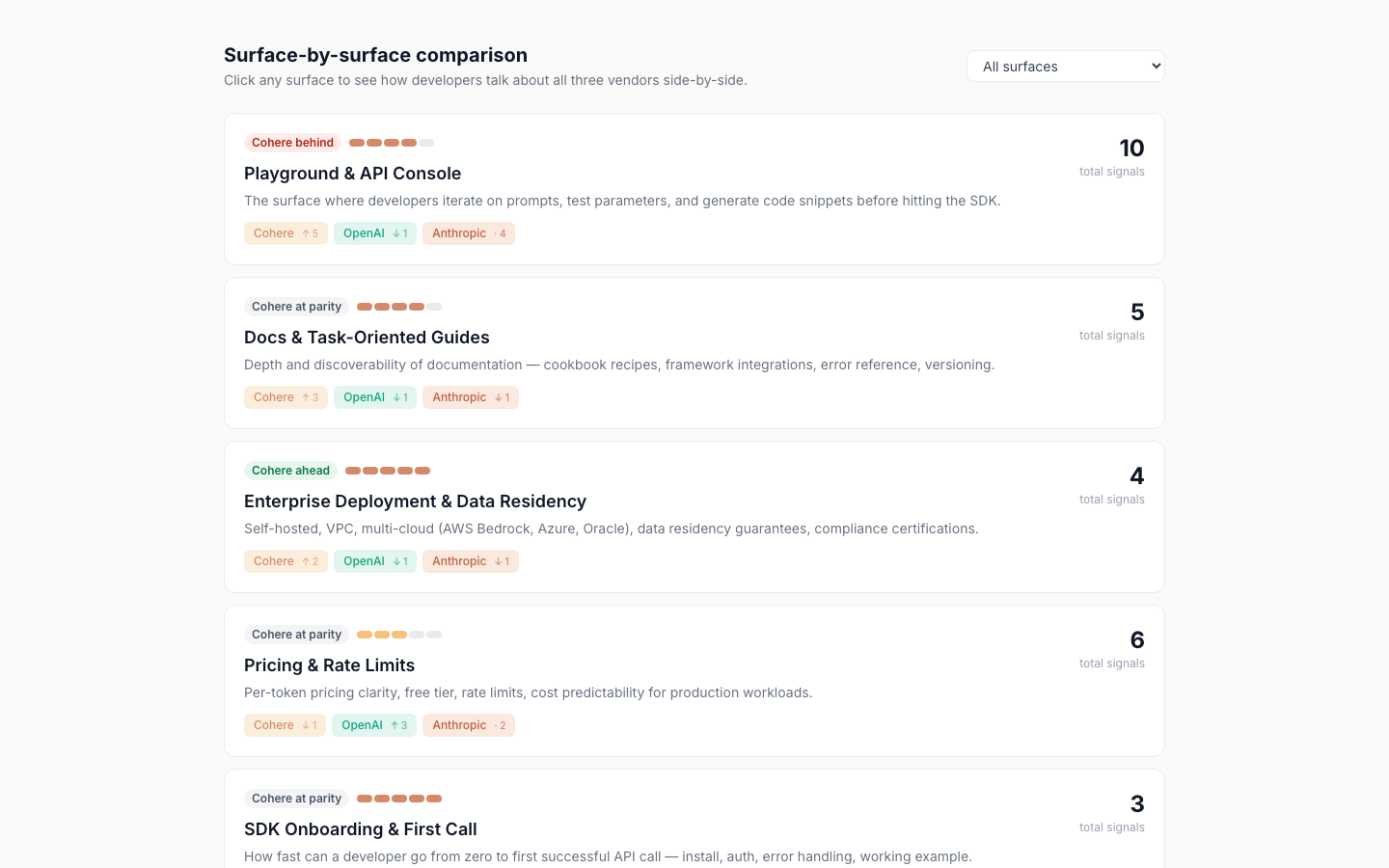
Vendor-by-vendor theme breakdown — Cohere, OpenAI, Anthropic.
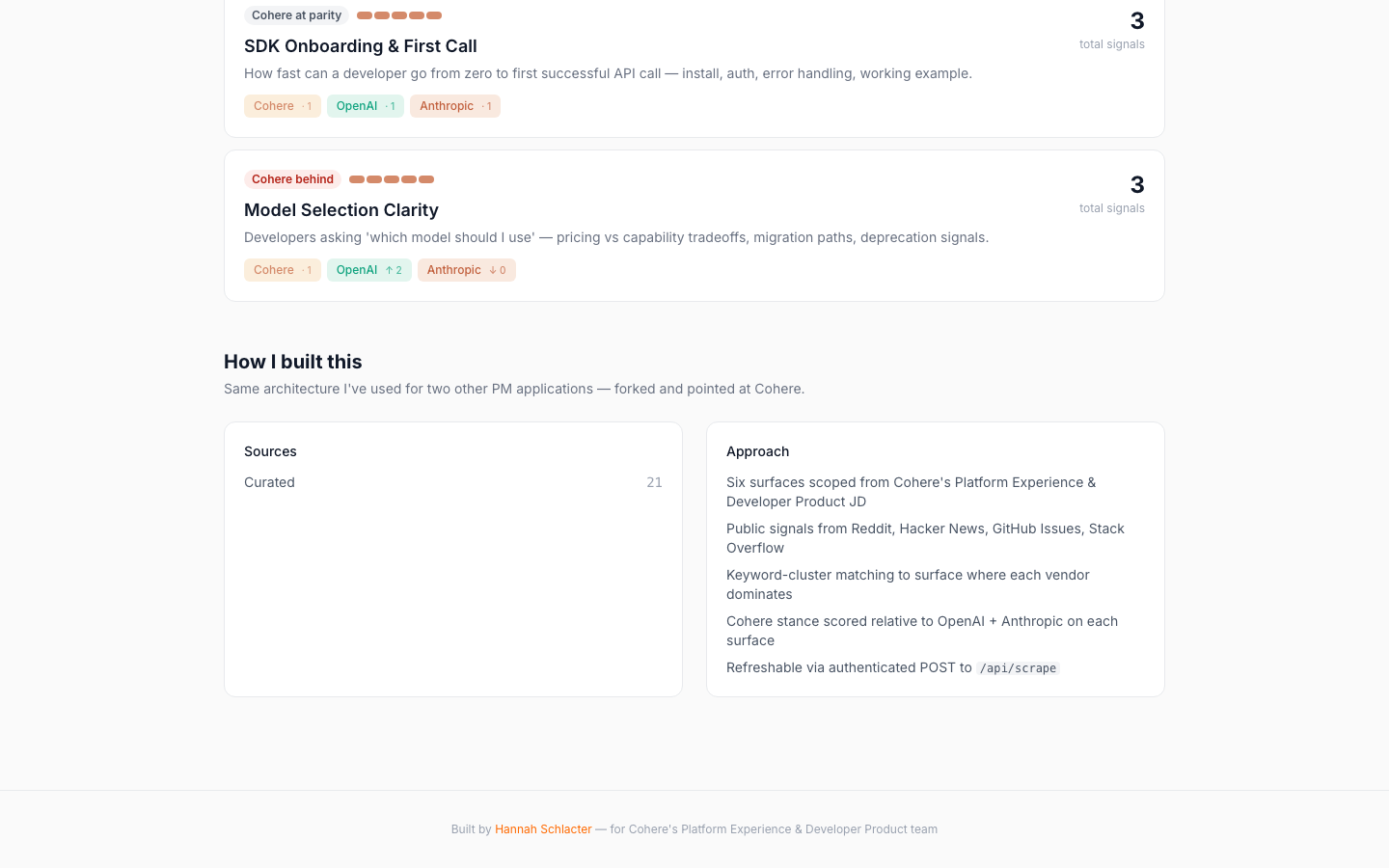
Every theme drills into source posts.