Career Kit
A specialized agent I built to run my own job search, then turned into a product anyone can install: 13 Claude skills that tailor resumes, write outreach and prep interviews, all from your own facts.
Get the Career Kit →The problem
A job search is the same chores on repeat: tailor the resume, write the note, check who wrote back. I was doing them with Claude, and the output was only as good as the facts it had. One resume took over three hours and 127 doc edits for nine bullets, because about 14 of my 46 messages were facts Claude didn't have, each one arriving after a bullet was already written and scored. Then I wanted to hand the whole thing to a friend who was job hunting, and everything I'd built was tangled up with my resume, my voice and my tracker.
My hypothesis
If every fact about a person lives in one private folder, and each chore is a skill with hard rules about what it may and may not do, Claude can do the chores in that person's voice without making anything up. Pull the personal data out of the skills, and the same agent works for anyone.
What I built
13 Claude Code skills in a public GitHub template: setup, resume, networking, recruiter-filter, job-search, linkedin-jobs, job-fetch, voice, aislop, project, resume-learn, career-review and interview. You make a private copy, open it in Claude Code, and say "set me up." Setup reads the resumes you've saved in Google Drive and a few things you wrote yourself, then fills one profile folder: your facts, your voice, your targets, your rules. Nothing it writes about you comes from anywhere else. From there you paste a job link and ask. It tailors a copy of your Google Doc resume and scores it the way a screening tool would. It drafts the LinkedIn note or referral ask in your voice, writes three sentences on why you fit, searches LinkedIn by years of experience, industry and pay, runs a mock interview, and logs it all to a tracker sheet. From the Claude app on a phone, a job link plus "make me a resume" puts a tailored PDF in your Drive. It gets better with use. Say "learn from this" and a correction becomes a rule. Every tailored resume is logged, so a similar job starts from the closest version. Every session records what it cost per skill, and a weekly review proposes a fix for the most expensive one as a pull request you approve. schlacter.me/career-kit is the front door, written for someone who has never used GitHub: what it does, what each connection unlocks, and five setup steps that remember where you left off.
What broke
The 127-edit resume taught me that an agent guessing at facts is worse than one that asks. Now every fact is searched for in an evidence file first, and whatever's missing comes back as one batched question before a word is written. Checking that a resume still fit on one page meant exporting the PDF into the conversation. 27 exports in one session blew through the context window. The check now runs outside the chat and returns two lines. Its first version only worked if the resume was shared publicly by link, so I moved it into a sandbox that reads Drive as the user. Nothing asks you to share a resume anymore. The quietest bug: LinkedIn's public job search ignores its own experience, remote, industry and pay filters. Same jobs either way, so those filters had never done anything. The search now reads each posting, applies them itself, and says what it dropped and why.
What I learned
A specialized agent gets good through its limits, not its prompt. The rules that matter are the ones that stop it: no fact that isn't in your folder, no rewrite of a whole Google Doc (a hook refuses the call), no email sent on your behalf. Splitting who you are (one private folder) from how the work gets done (the skills) is also what made it a product. A user can pull my updates without touching their data, and a leak check keeps my data out of the template. The last piece was the page: most people who'd use this have never opened GitHub, so every step is written for them.
If I kept going
Answers for application form questions, LinkedIn profile edits and offer negotiation are the gaps I'd fill next. I'd also like the phone flow to start from the share sheet: see a job, tap Share, get a resume.
What was built
13 skills
One per job-search chore
- Resume tailoring and fit scores
- Outreach and why-me, in your voice
- LinkedIn search and full job posts
- Interview prep and mock rounds
- Tracker and weekly review
Your profile
One private folder, the only source of facts
- Facts, each with its source
- Voice rules from your own writing
- Targets and dealbreakers
- Which story leads for which role
- Rules learned from your corrections
Guardrails
Refuse the moves that do damage
- Hook blocks whole-doc rewrites
- Exact-match edits, on a copy only
- Gmail read-only, never sends
- Leak check keeps data out of the template
Connections
Each one lets it do more itself
- Google Drive and Docs
- Gmail
- Composio for the tracker sheet
- Bundled LinkedIn jobs server
Gets better
Learns from every session
- "Learn from this" saves corrections
- Reuses past tailored resumes
- Token meter per skill
- Weekly review proposes a fix
The front door
schlacter.me/career-kit
- Plain-language setup, 5 steps
- Progress saved in the browser
- Share link with private counts
Prototype
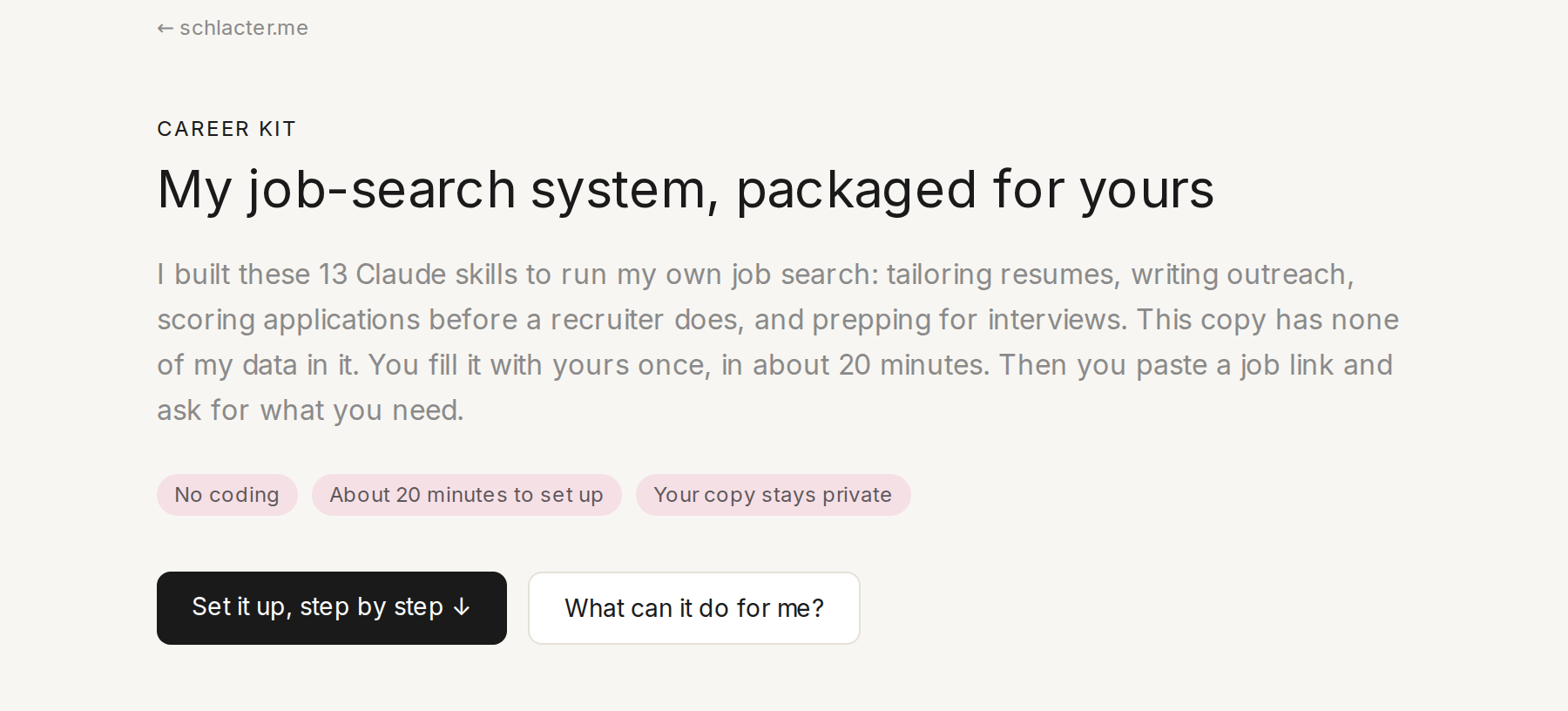
The front door at schlacter.me/career-kit: what it is and what it's for, before anyone sees GitHub.
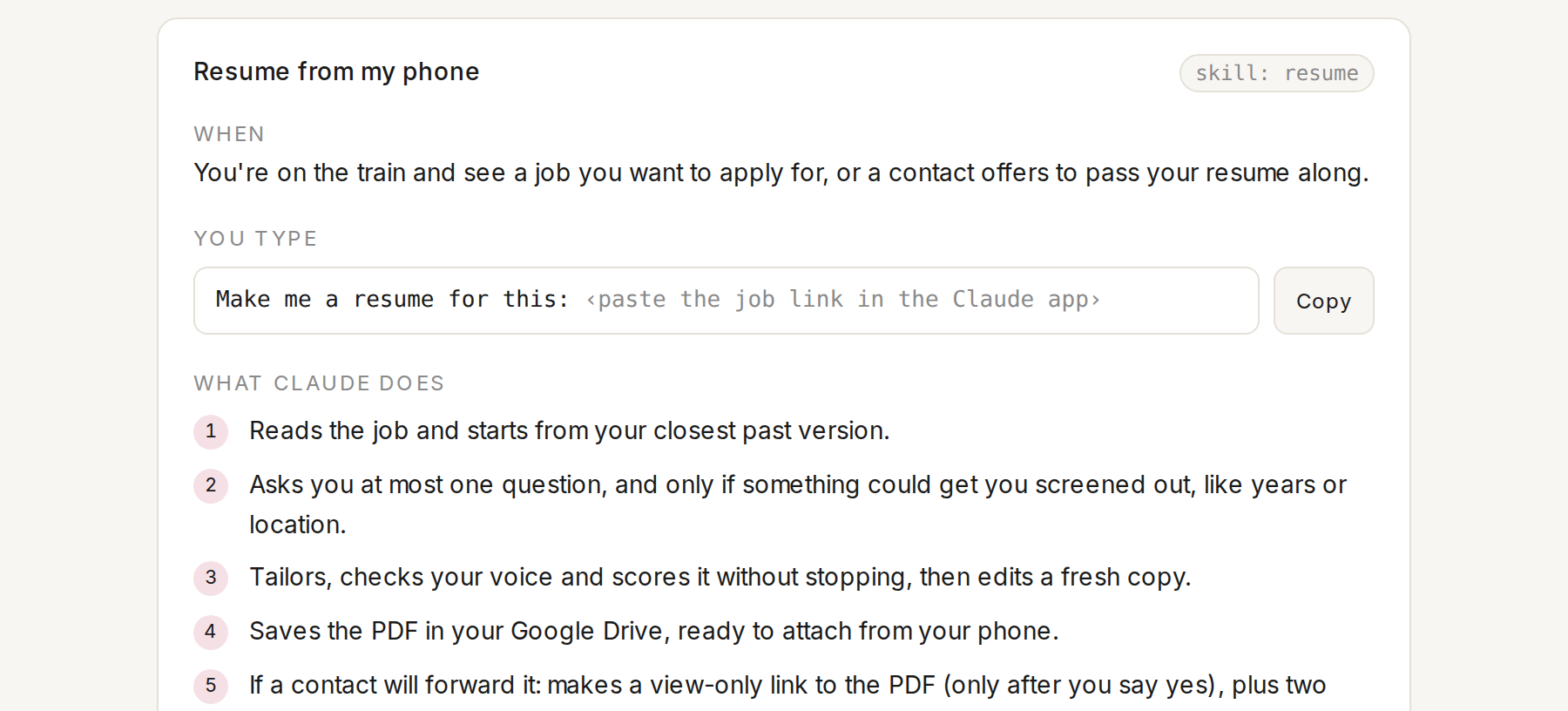
Every use case shows what you type, what Claude does and what you get. This one runs from the Claude app on a phone.
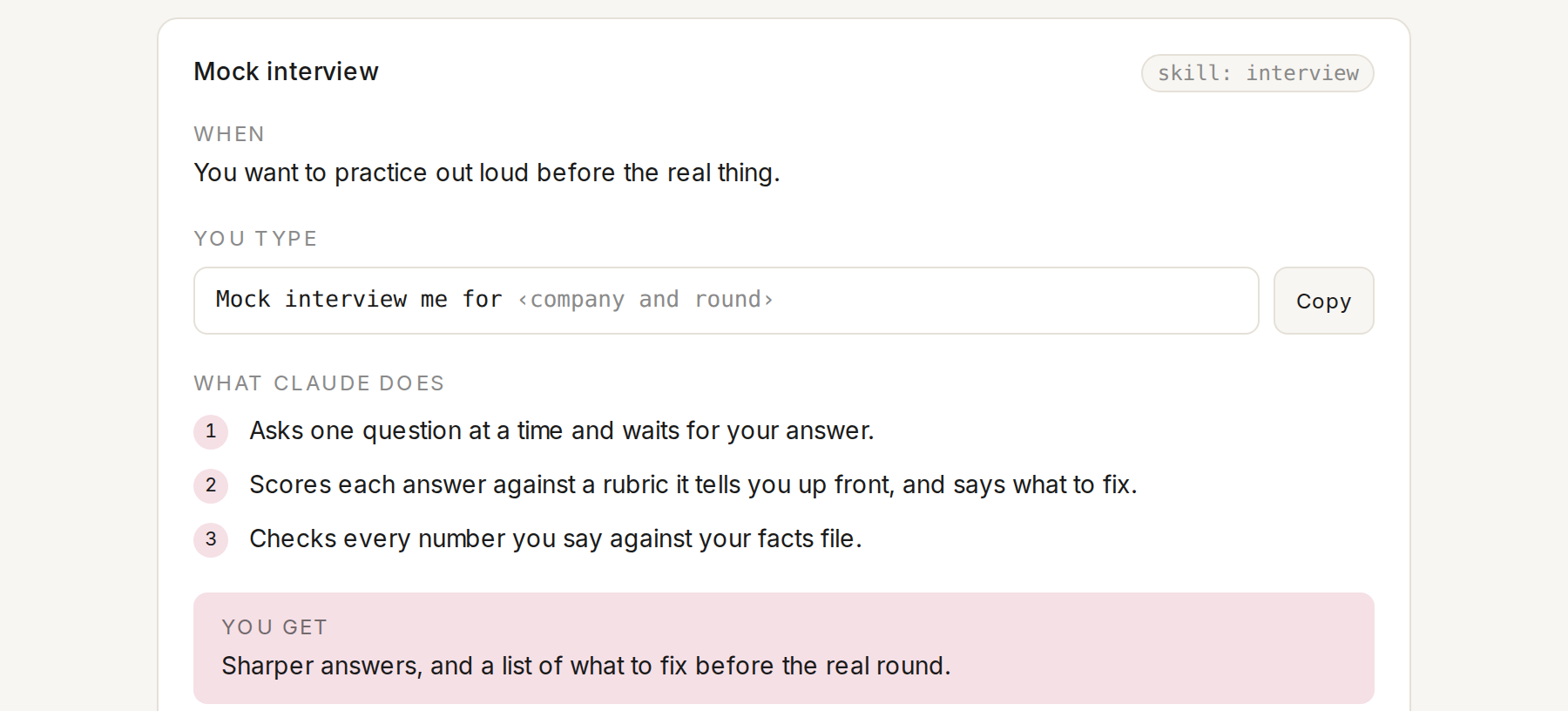
Interview prep: mock rounds one question at a time, scored against a rubric it states up front.
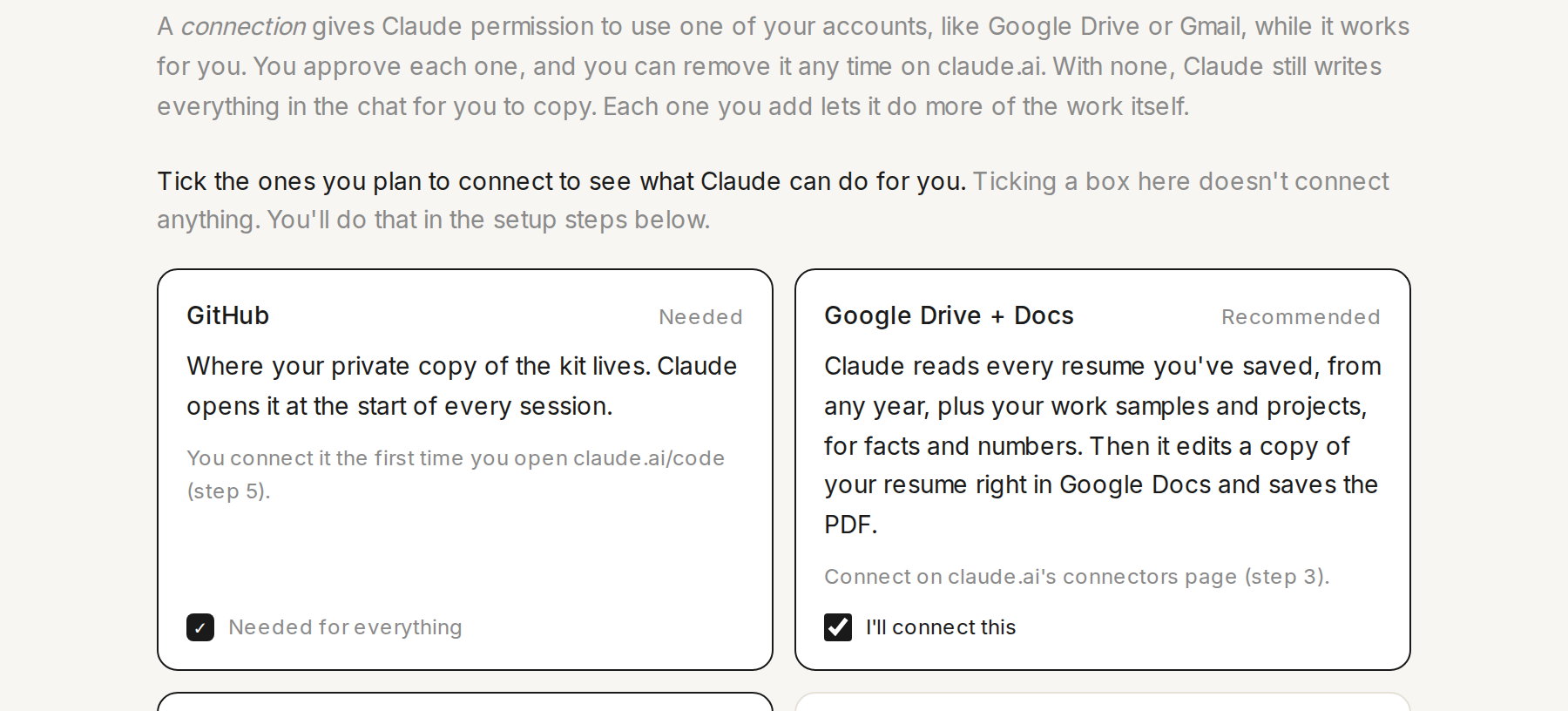
Tick a connection to see what it unlocks. With none, Claude still drafts everything in the chat.
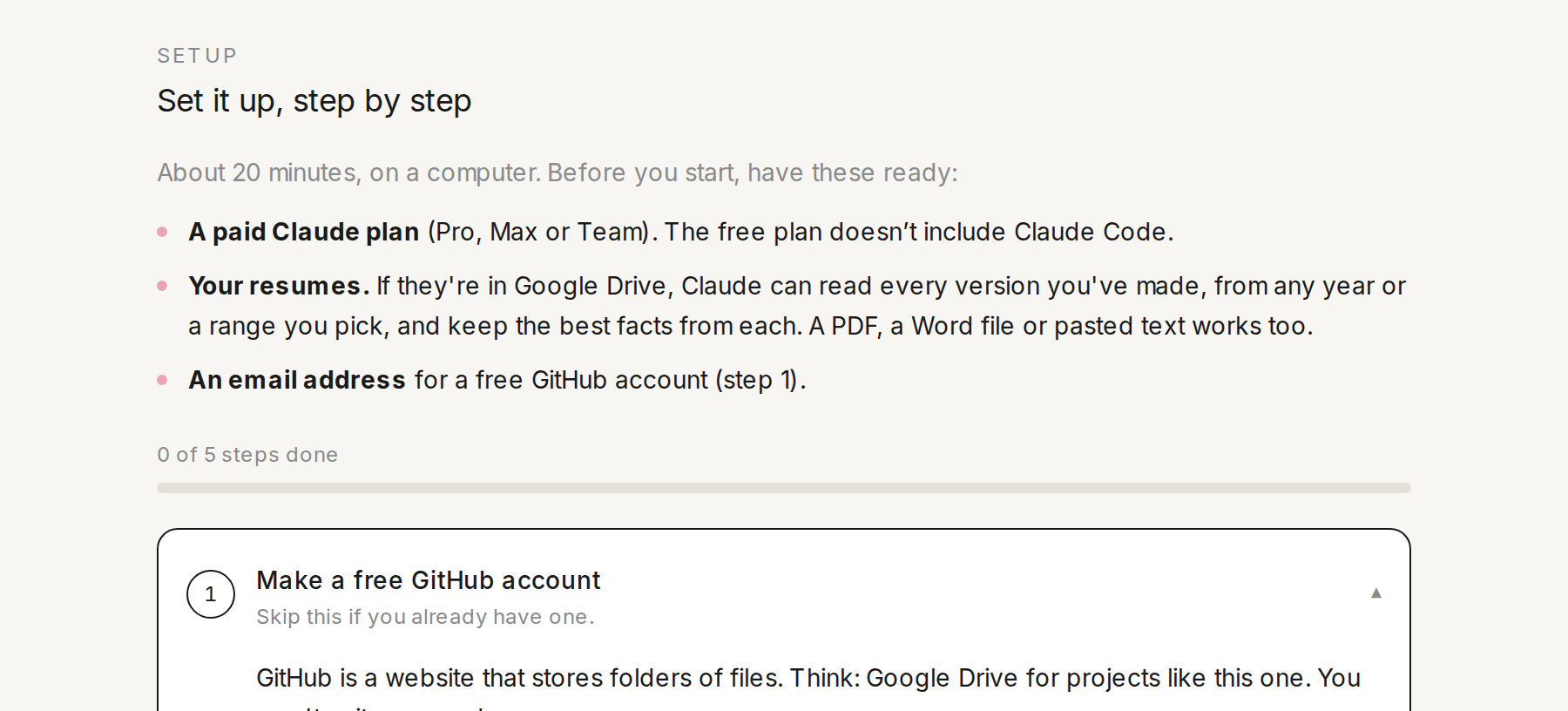
Five setup steps written for someone who has never used GitHub. Progress saves in the browser.